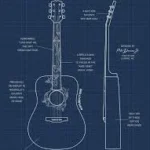

Work in Progress

Work in Progress

BACK CUT AND THINNED OUT

Back ready for adding center piece made of figured maple.

The main wood is African Mahogany.

BACK & SIDES

Back and sides are thinned and shaped.  The sides are ready for bending and the center strip has been glued to complete the back piece.

TESTING FOR COLOR OF WOOD

I wet the back piece to see how the colors of the wood will look when clear coat is added.

Beautiful colors.

PREPPING FOR SIDE BENDING

This form is used to bend the sides of the guitar into the shape of the guitar body.

Heat and dampened wood steams the sides into the desired shape.

SIDE BENDING

The wood is moistened, placed into aluminum foil, then placed between 2 metal plates and a heating blanket.

When the wood is heated to a certain temperature, the sides are slowly bent into shape, then cooled.

SIDES BENT 

Now that the sides are bent, they are kept in this form to retain the shape until the back is glued onto the sides.

SIDES BENT 

Kerfed lining is added to the sides on the top & bottom.  This is the wood where you see little spaces around the edge of the body.  This lining will act as a shelf, when glued, will hold the back & top to the sides.  This will end up completing the “box” of the guitar body.

BACK BRACING ADDED

Bracing has been added to add strength and support to the back.  Bracing cut, shaped and glued to the back.  Ready to join the back to the sides.

JOINING THE BACK TO THE SIDES

The sides and back are glued together and placed into a “go bar” system.  The sides and back are held in place by the bracing keeping even downward pressure around the entire body.  Left for 24 hours for the glue to set.

JOINING THE BACK TO THE SIDES

The sides and back are glued together and placed into a “go bar” system.  The sides and back are held in place by the bracing keeping even downward pressure around the entire body.  Left for 24 hours for the glue to set.

BACK & SIDES JOINED & SANDED

The sides and back are now a single unit.  Sanding has been done to even out the wood surface.  You can see where the back is glued to the “kerfed” lining.  Now ready to work on the top aka the “sound board.”

BACK & SIDES JOINED & SANDED

The sides and back are now a single unit.  All sanded and ready to join the top to the bottom when the top is ready to go.

ROSETTE INTO TOP

Marking off the top where the rosette will be located on the guitar top.

ROSETTE INTO TOP

Cutting the groove where the rosette will be inlayed into top.

ROSETTE INTO TOP

The rosette groove is cut and the rosette made of figured walnut in inlayed and sanded.

FRETBOARD VALIDATION

Checking out fretboard placement and where to cut the fretboard around the sound hole.

FAVORITE PART OF GUITAR BUILD PROCESS

May sound weird, but I love pulling off the glue from my fingers once I’ve glued up the bracing onto the guitar top.

GUITAR TOP BRACING

Placing cut bracing onto top to verify location.  Once glued onto the top, the bracing will be shaped to achieve the best sound quality and volume;

GLUING BRACING TO TOP

Gluing bracing to top that has been radiused at a 16 ft. radius.  This will give the guitar top a curve below the sound hole.  This helps determine sound projection and tone.

GLUING TOP TO BODY

The top is now glued to the body.  This completes the “box” of the guitar.

THE BOX IS DONE!

The body of the guitar is done and sanded.

THE TAILPIECE INLAY

The base of the guitar body has been cut and inlayed with a combination of materials to make a very nice decoration.

CUTTING CHANNEL FOR BINDING

Adding binding adds a distinctive flair to the guitar body.  To inlay the binding a channel has to be cut around the top and back of the body.

GLUING THE BINDING AROUND THE TOP OF THE GUITAR

The binding has placed in the binding channel and taped to the body after gluing to keep the binding in place.

GLUING THE BINDING AROUND THE TOP OF THE GUITAR

The binding glue process is done for the entire top.  Next stop?  Adding binding to the back.

TOP BINDING IS DONE

The top binding is glued and sanded.  Looks awesome!

TOP BINDING IS DONE

The top binding is glued and sanded.  Looks awesome!

CUT MORTICE FOR NECK

The mortice is cut in the body so we can insert the tenon from the neck.  This will secure the neck to the body.

CUT TENON ON THE NECK

The tenon is cut in the neck that will be inserted into the mortice (slot) on the body to secure the neck to the body.

WORKING ON NECK

Finished fretboard and gluing to neck

WORKING ON NECK

Finished fretboard and gluing to neck

SHAPED FRETBOARD TO NECK AND DOING TEST FIT TO BODY

Test fitting the neck to the body.  Next steps are to finish carving the back of tbe neck to shape properly for playability.

SHAPED FRETBOARD TO NECK AND DOING TEST FIT TO BODY

Test fitting the neck to the body.  Next steps are to finish carving the back of the neck to shape properly for playability.

SHE IS GOING TO BE A BEAUTIFUL GUITAR!!!!!!!

EM-330 Hollow-body

PREPPING FOR THE DESIGN STAGE

Talking to customer about specific requirements on semi-hollow body electric guitar.

GUITAR BODY TEMPLATE

Guitar body template has been cut and will add sound holes to this template in order to cut them into the top

FRETBOARD SLOTS 

Fretboard slots cut for the fretboard

NECK PREPARATION

Cut and shaped back of maple neck and checking fretboard against neck

HEADSTOCK SHAPE

Purposely create a paddle head on the neck when I designed the neck shape when I use the CNC machine, allowing any design for a headstock.  This will be the headstock shape for this guitar.

Review My Order

0

Subtotal

 
0

Subtotal